In the rice plains of central Thailand, farmers once raced the buffalo that ploughed their fields. The animal is gone. The race is not.

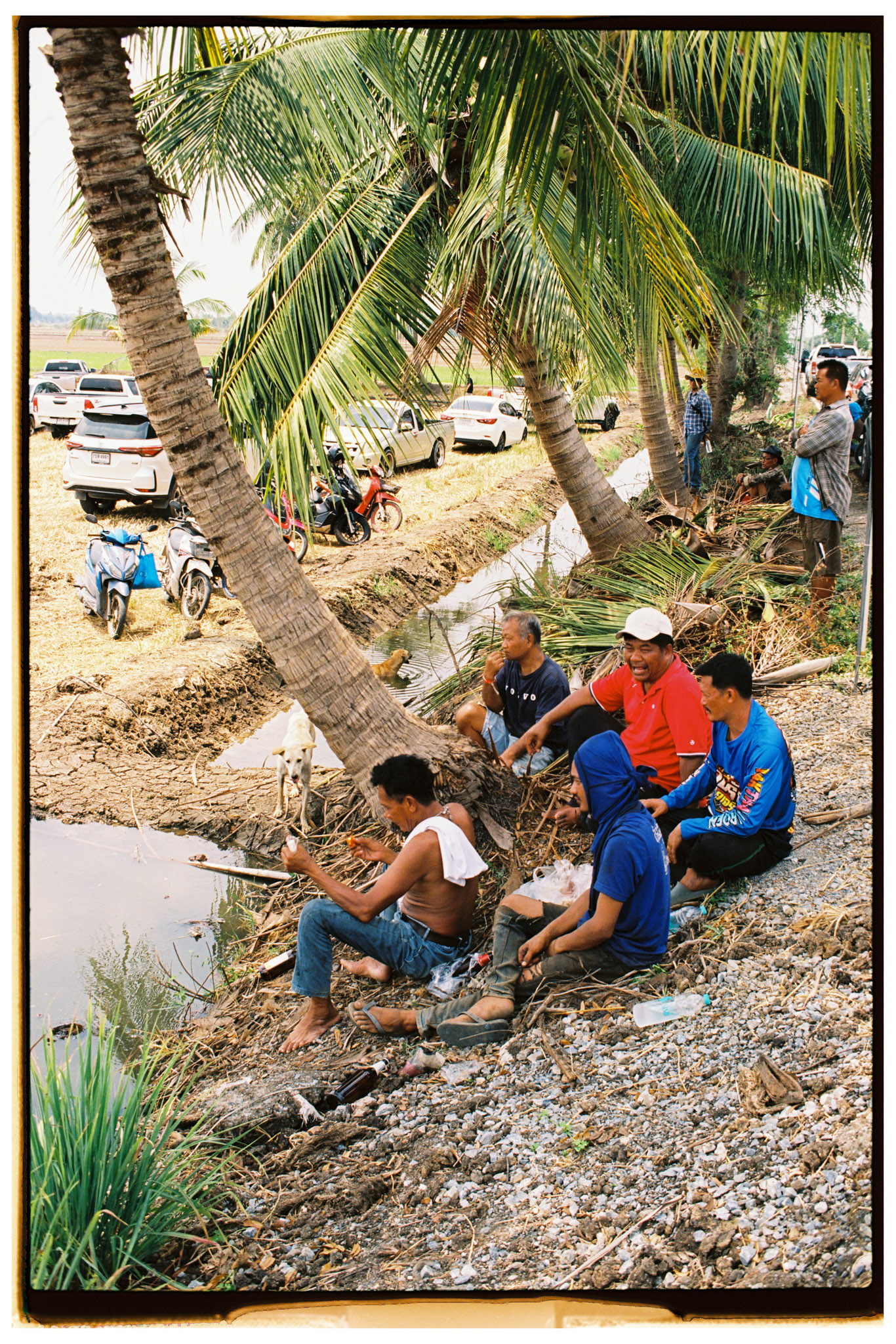
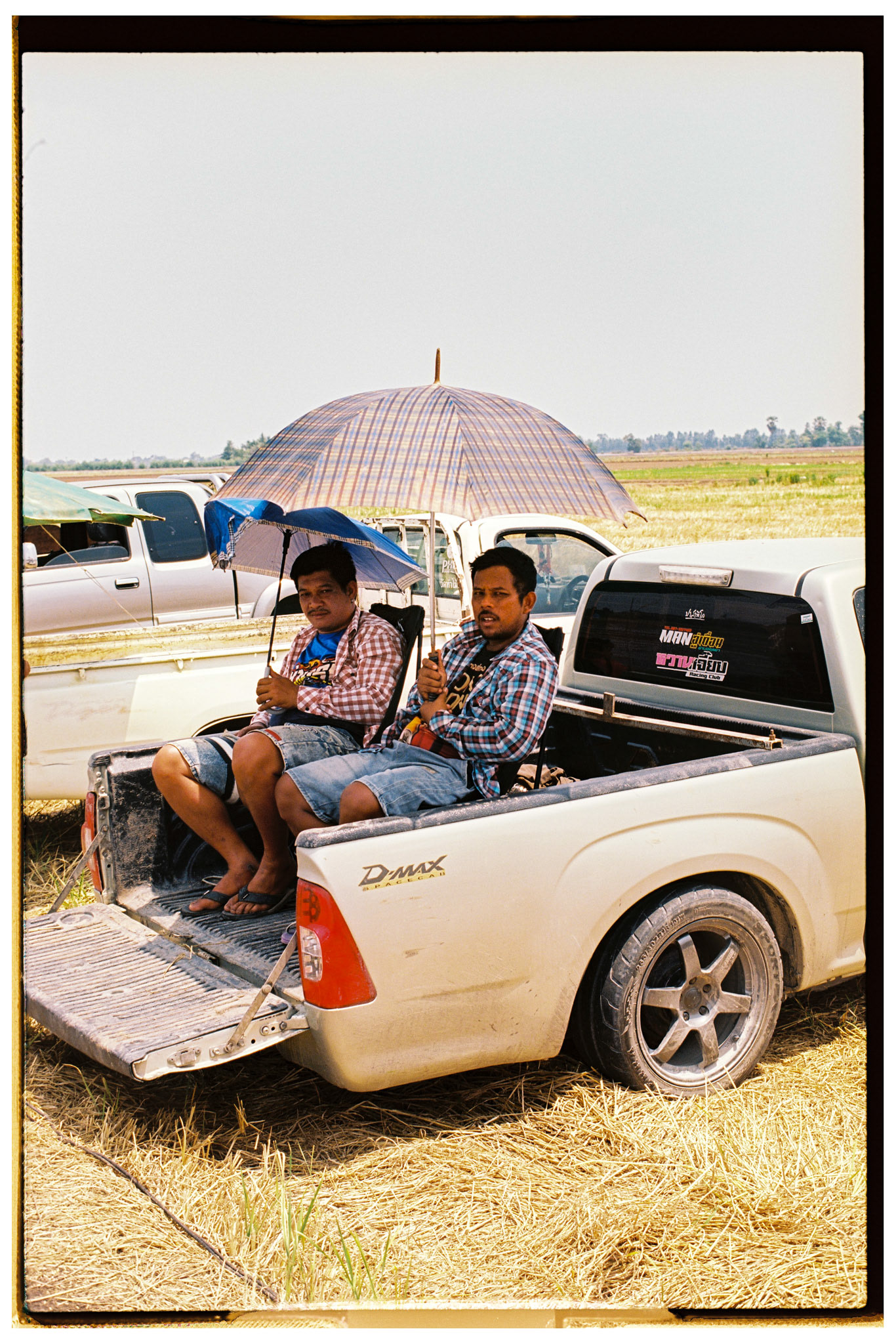
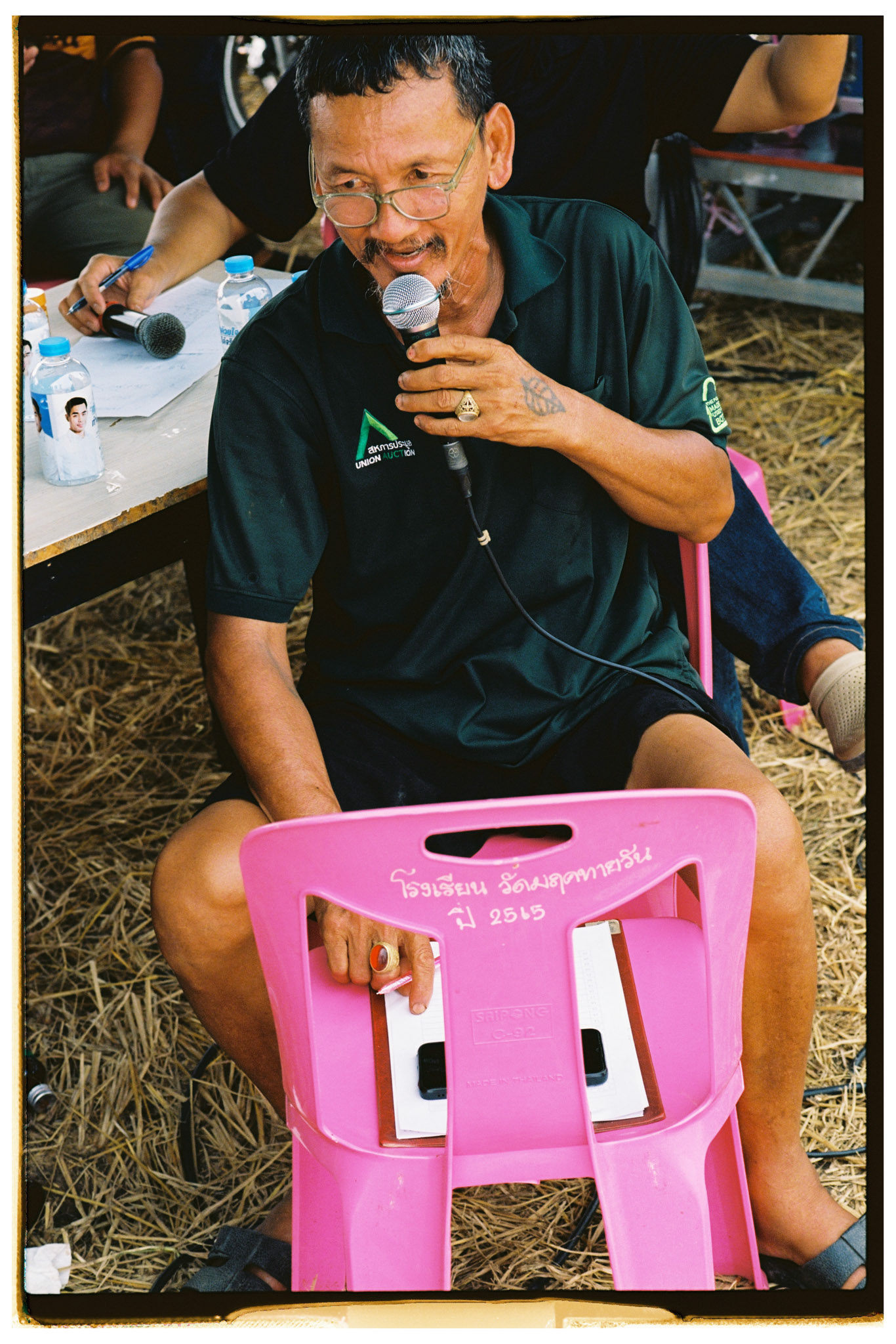
The road runs straight through the plain, flanked on both sides by paddy fields; nothing breaks the monotony of the landscape. Then, after turning right at Wat Maruekhathayawan, a row of blue and green canopy tents appears. Behind them, two dozen pickup trucks park on the side. And rising above everything, a sound: the loud single-cylinder diesel engines of the modified two-wheel walking tractors racing down the ทางเลน (tang len): a strip of flooded paddy.
This is รถไถนาซิ่ง (rot thai na sing), "speeding rice-field tractor racing", also known as ศึกควายเหล็ก (Suek Kwai Lek), "iron buffalo battles."


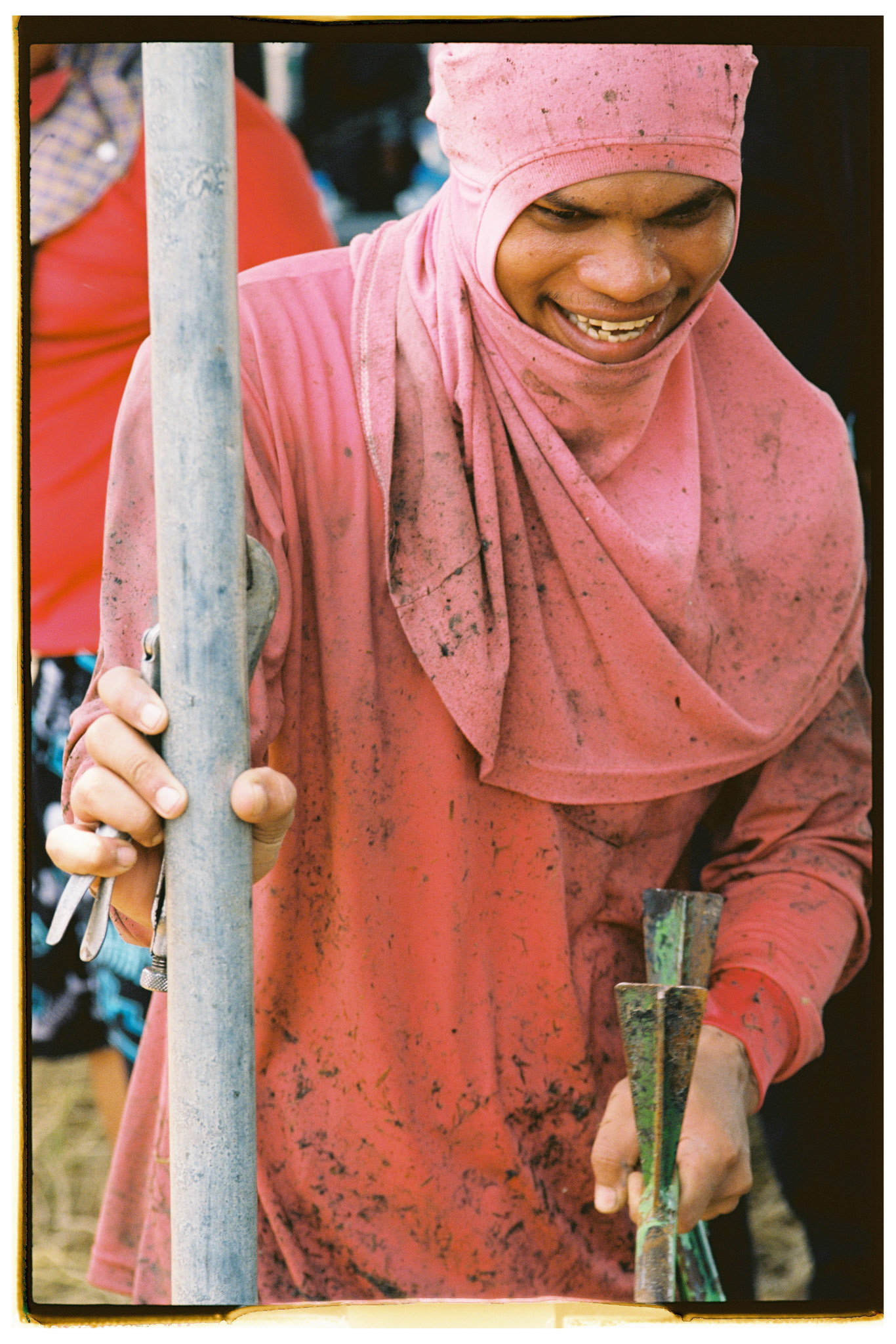
In their agricultural form, the two-wheel walking tractor is the backbone of rice farming across Southeast Asia: a long-handled, single-axle machine designed to be walked through a flooded field pulling a plough. For racing, the transformation is comprehensive. The engine (typically a Kubota, Yanmar, or Honda diesel) is tuned and over-pressurized well past its rated output. A plastic cowling wraps the body to deflect mud. Standard wheels are replaced with large iron rims fitted with paddles or spikes designed to bite through waterlogged soil at speed. The rider stands on a flat iron platform welded behind the axle, or on two narrow runners like skis, gripping long handlebars that transmit every vibration of the engine directly into the arms. No real seat, no suspension, just speed, balance and faith.
The iron buffalo replaced the living one within a single generation. In the late 1950s, M.R. Debriddhi Devakul designed a walking tractor for the Thai Rice Department: a machine that could plough a flooded paddy without eating, sleeping, or falling ill. Japanese manufacturers established factories across Thailand; by the 1990s, the water buffalo had almost disappeared from the rice plains. The annual buffalo race, a tradition documented in the Ayutthaya region for more than two hundred and fifty years, did not disappear with it. It just evolved.
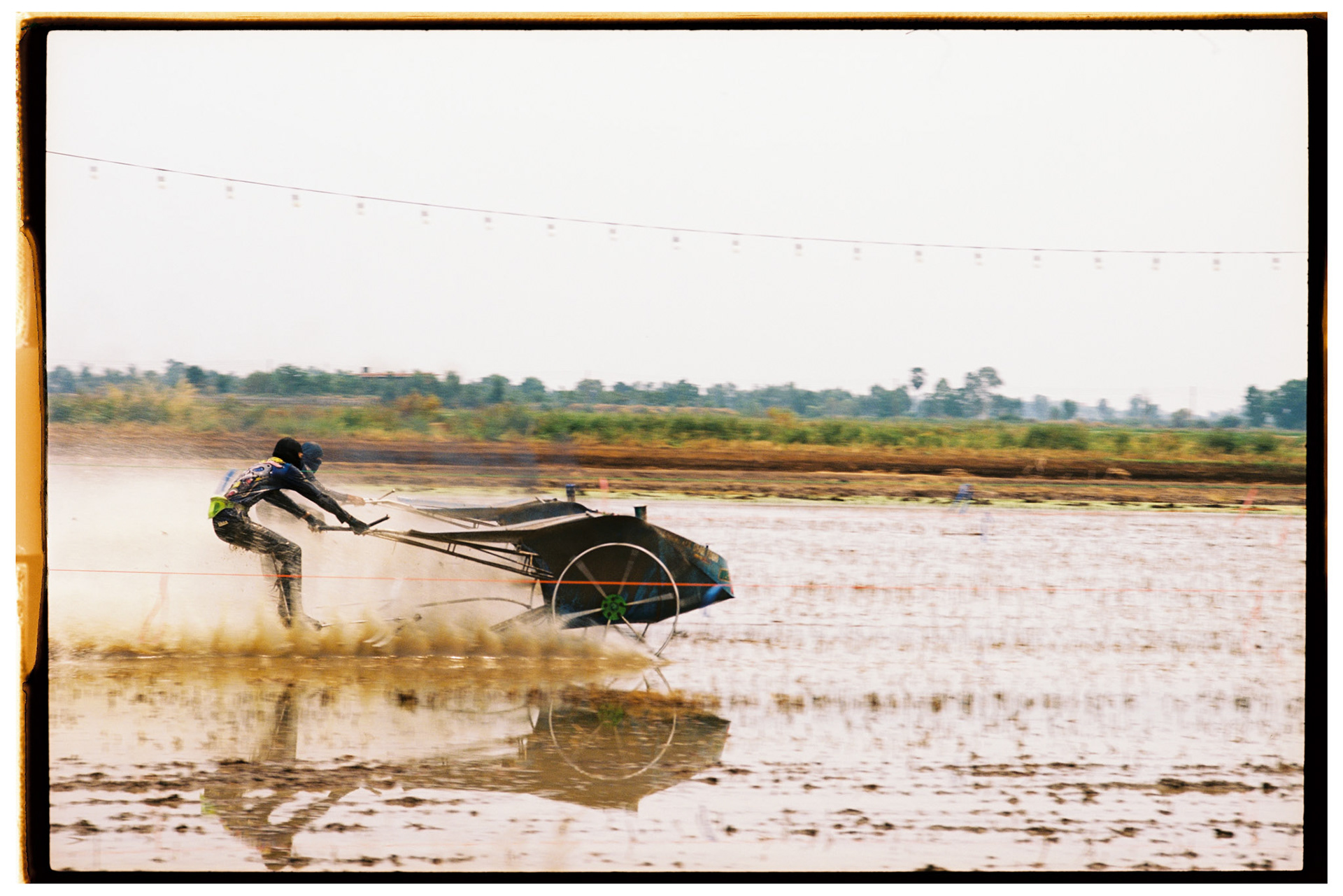
The racing circuit runs through the dry season: December to April, after the main นาปี (na pi), the rain-fed wet-season crop. A professional rider will race several events across the season, travelling from Phitsanulok in the north to Nakhon Pathom in the west. The events are loosely connected, with no central body and no fixed calendar. The prize money varies: 5,000 to 6,000 baht per event, enough to cover fuel, parts, and travel. The community that follows it is large enough to have sustained a dedicated television series on Thai PBS and to have made ดีเจไก่ไลฟ์สด (DJ Kai Live Stream) one of the most-followed rural sports media accounts in Thailand, with over 600,000 Facebook followers.
Ayutthaya Province does two crops a year. The May race at Wat Maruekhathayawan comes after the นาปรัง (na prang) dry-season harvest in March–April, in the window before ดำนา (dam na), transplanting, begins. It is a late-season event, the last race before the fields go back to work for another cycle.


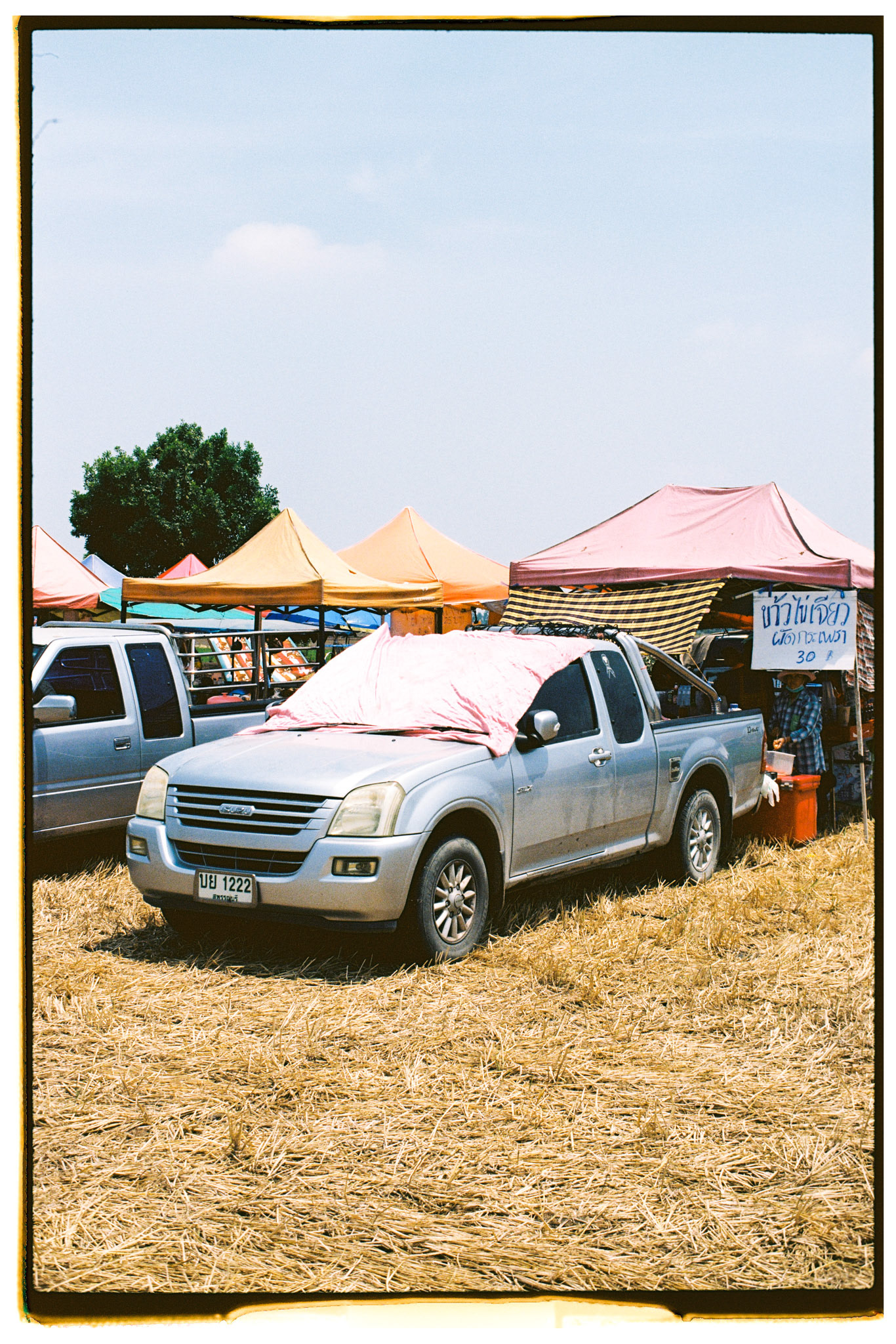


The competition at Wat Maruekhathayawan runs a single class: the two-wheel walking tractor only. The format is a straight knockout bracket. Two machines line up at one end of the tang len, a flooded straight of approximately one hundred metres, marked by flags stuck into the mud. At the signal, both go. First to the far end advances; the loser is eliminated. Three runs per pairing cover the case of a capsize or mechanical failure on the first pass. The machines run at the edge of their tolerance and the field offers no predictable surface: a hidden furrow or patch of deep mud can send a machine sideways, capsizing rider and tractor into eighteen inches of water.


At the edge of the tang len, someone has fixed a garland of marigolds to a stake beside a row of whiskey bottles, an offering to the spirits of the field, or insurance, or both. In Thailand the ritual acknowledgment and the practical preparation occupy the same gesture. By the next morning, the machines will be loaded onto the back of the pickup trucks, the canopies folded, a few Singha and Sang Som later, back to the farm work. In a few weeks the seedlings go in. In five months the harvest comes. And in December, when the plains empty again, the iron buffaloes will run.